Overview
In 2026, programming is more than a technical skill—it’s a new kind of literacy. It’s the ability to understand, command, and collaborate with the technology that surrounds us. Whether you want to boost your career, automate the boring parts of your life, or simply understand how the digital world works, learning to code teaches you essential life skills: logical thinking, creative problem-solving, and resilience. That’s why, now more than ever, programming is the ultimate must-have life skill.
What is programming?
We all have computers, tablets, or mobiles at home that want to do things for us. We built them to expect our next instructions. Take as an example your phone. Your phone does nothing until you give him the next instruction whether it’s playing a video, taking a photo, or saving a file. All our devices are waiting to do things for us. When we program we are taking advantage of our hardware and devices to do useful things for us.
We live in a world run by software. The apps that entertain us, the navigation systems that guide us, and the automated systems that are increasingly part of our cities (like self-driving cars, which are now a reality on roads in many places) are all brought to life by code. Learning to program is like getting a behind-the-scenes look at how the 21st century works. It’s as fundamental as understanding basic biology or physics.
What do you learn from programming?
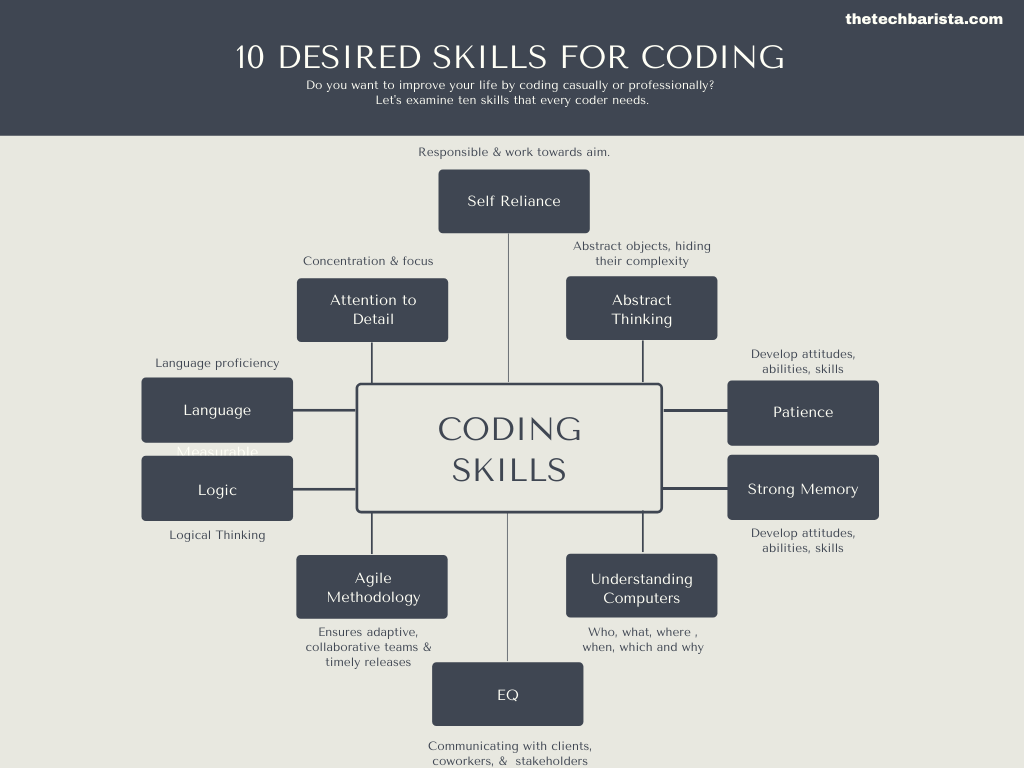
When you learn to code, you’re not just learning a computer language. You’re training your brain to think in a new, more powerful way. You learn to:
- Build Resilience and Attention to Detail: Your code will rarely work on the first try. You’ll learn to troubleshoot, to search for that single misplaced comma, and to persevere until you find a solution. This “debugging” mindset is invaluable in life.
- Become a Better Problem-Solver: You learn to take a big, messy problem and break it down into small, manageable steps. This skill, called decomposition, is useful for everything from planning a project at work to organizing a family move.
- Think Logically and Clearly: Computers have no common sense. They do exactly what you tell them. This forces you to be precise and clear in your thinking, leaving no room for ambiguity.
Who can program?

Forget the old stereotype of the loner programmer in a hoodie, living on energy drinks. That image is decades out of date. The truth is, programming is for everyone, regardless of age, background, or current job.
In 2026, the rise of powerful AI assistants (like ChatGPT and GitHub Copilot) has made coding more accessible than ever. These tools act like a super-smart partner who can help you write code, explain concepts, and catch your mistakes. You don’t need to be a math whiz or a computer genius. You just need curiosity and a willingness to experiment. In fact, many schools now teach coding as part of the standard curriculum, meaning the next generation is growing up with this skill. Now is the perfect time for you to join them.
Why do you want to start programming?
There are lots of reasons why you may want to start programming.
Programming as a career choice
Let’s be direct: software developers are in high demand. A career in tech can offer a great salary, incredible flexibility, and the opportunity to work on projects that reach millions of people. In a world where remote and hybrid work is the norm, programming skills give you a passport to work for companies anywhere on the globe. But a word of advice: while the financial rewards are real, the most successful developers are the ones who are genuinely curious and enjoy the process of creating and problem-solving.
Programming for personal growth
You don’t have to become a professional developer to get life-changing value from coding. Maybe you’re a small business owner drowning in spreadsheets, a scientist with messy data, or just someone with a creative idea for an app. Learning the basics of a language like Python can help you automate tedious tasks, analyze data more effectively, and build simple tools for your own use. The goal is to make the computer serve you, not the other way around. And with AI to help, writing a useful script for yourself is easier than learning a new recipe.
How do you program computers?
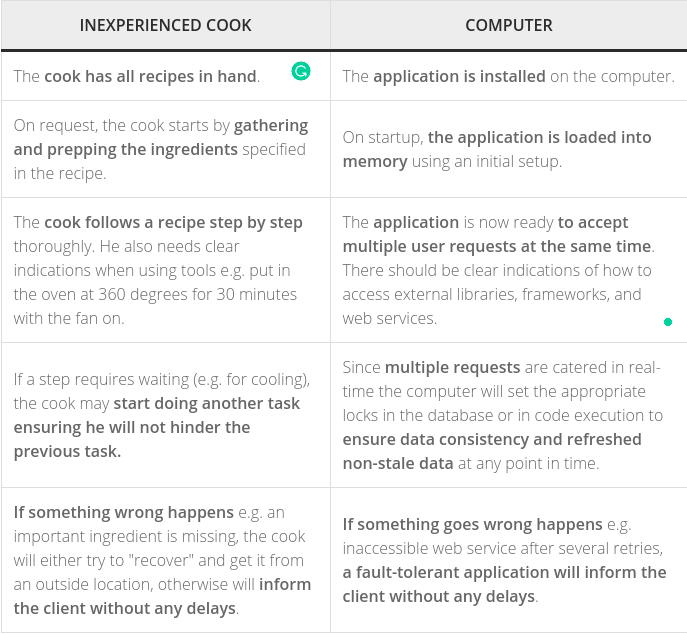
Computers are like inexperienced cooks!

Imagine a brilliant but completely inexperienced cook who has never set foot in a kitchen. To make a specific dish, you must give them an impossibly detailed, step-by-step recipe: “Pick up the knife. Move your hand 12 inches to the left. Grip the tomato. Apply pressure…” A human cook would get bored and start guessing. A computer, however, will not. It will simply stop and refuse to continue if even one tiny detail is missing.
Programming is like writing that impossibly detailed recipe. Your job is to translate what you want to achieve into the precise, literal language the computer understands.
Scenario: Inexperienced Cook vs Computer
How does a programmer think?

In order to develop programs for end-users, you should imagine yourselves as being inside the computer. As a computer, you will be able to access the hardware components and peripherals. This includes the central processing, memory, network connection, disk drive, permanent storage mediating to accomplish what the user needs.
To think like a programmer, you have to practice a few key habits:
- Literal Precision: You must assume the computer will take every single word you write exactly as written. “Its,” “it’s,” and “its” are three completely different things to a computer. You can’t be sloppy.
- Decomposition: You must become an expert at breaking problems down. The task “send an email” becomes: “Connect to the server. Authenticate user. Check for internet connection. Compose email header. Add recipient address. Add subject line. Add body text. Send.”
- Collaboration (with AI): In 2026, a key part of a programmer’s thinking is knowing how to ask the right questions. You need to be able to clearly describe your goal to an AI assistant, understand the code it gives you back, and then tweak and improve it. It’s a partnership.
What is the best language to start programming?
There’s no single “best” language, but for a beginner in 2026, one clear winner stands out:
Python remains the undisputed champion for beginners. Its syntax is clean, readable, and almost like plain English. You can write a working program with a single line of code. More importantly, Python is the language of two of the most exciting and in-demand fields right now: Data Science and Artificial Intelligence. By learning Python, you’re building a foundation for the future.
However, the journey doesn’t have to stop there. With the help of AI coding tools, many beginners now find it easy to explore other areas. You might use JavaScript to add interactivity to a website, or a modern language like Rust or Go if you get interested in high-performance systems. Starting with Python gives you a solid foundation, and AI is the perfect guide to help you explore from there.
Conclusion
Still not convinced? The best way to understand the power of programming is to try it. It’s a creative, challenging, and deeply satisfying pursuit. You don’t need to build the next big app on day one. Just start small, be curious, and use the amazing tools (and AI assistants!) available to you. A new way of thinking about the world is waiting for you, one line of code at a time.